---
title: "NFL WR Injury Analysis"
description: "Exploring whether height and weight are associated with season-ending injuries among notable NFL wide receivers (2016–2026), motivated by the Chargers drafting Brennan Thompson — an extreme outlier by size."
categories: [NFL, R, ggplot2, tidyverse, Sports Analytics]
date: 2026-05-06
format:
html:
toc: true
code-fold: true
---
## Background
The Los Angeles Chargers made headlines by selecting **Brennan Thompson** — a wide receiver listed at just 5'9" and 164 lbs — in the 2026 NFL Draft. At those measurements, Thompson is a genuine outlier among NFL wideouts: lighter than any established receiver in recent memory and among the shortest in the league.
This raises a natural question: *do smaller, lighter receivers get hurt more often?* To explore it, I assembled a dataset of 170 notable NFL wide receivers from 2016–2026 and looked at whether physical size correlates with season-ending injury rates. No modeling — just the data and clean visualizations.
## Data
```{r}
#| label: setup
#| message: false
#| warning: false
library(tidyverse)

df <- read_csv("../assets/NFL_WR_injury_data.csv") %>%
  rename(Injured_raw = `Season-Ending Injury`) %>%
  mutate(
    Height_in = {
      m <- str_match(Height, "(\\d+)'(\\d+)")
      as.numeric(m[, 2]) * 12 + as.numeric(m[, 3])
    },
    Weight_lbs = as.numeric(str_extract(Weight, "\\d+")),
    Injured = if_else(Injured_raw, "Season-Ending Injury", "Not Injured"),
    Injured = factor(Injured, levels = c("Not Injured", "Season-Ending Injury"))
  )

brennan <- df %>% filter(Player == "Brennan Thompson")

cat(sprintf(
  "Dataset: %d receivers | %d with season-ending injuries (%.0f%%)\n",
  nrow(df), sum(df$Injured_raw), mean(df$Injured_raw) * 100
))
```
The dataset covers **`r nrow(df)` notable NFL wide receivers** with documented injury histories from 2016–2026. Each player is coded as having suffered a season-ending injury (TRUE) or not (FALSE) during that window. Height and weight are parsed from their string formats into numeric values for analysis.
## Analysis
### Height vs. Weight — Where Does Thompson Fit?
```{r}
#| label: scatter
#| fig-width: 9
#| fig-height: 6
pal <- c("Not Injured" = "#013369", "Season-Ending Injury" = "#D50A0A")

fmt_height <- function(x) paste0(x %/% 12, "'", x %% 12, '"')

ggplot(
  df %>% filter(Player != "Brennan Thompson"),
  aes(x = Weight_lbs, y = Height_in, color = Injured)
) +
  geom_point(size = 3, alpha = 0.72) +
  geom_point(
    data = brennan,
    aes(x = Weight_lbs, y = Height_in),
    color = "#FFB612", size = 6, shape = 18, inherit.aes = FALSE
  ) +
  geom_label(
    data = brennan,
    aes(x = Weight_lbs, y = Height_in, label = "Brennan Thompson\n5'9\", 164 lbs"),
    color = "black", fill = "#FFB612", fontface = "bold",
    size = 3.4, nudge_y = 1.7, nudge_x = 6,
    inherit.aes = FALSE
  ) +
  scale_color_manual(values = pal) +
  scale_y_continuous(breaks = seq(66, 78, 2), labels = fmt_height) +
  labs(
    title = "NFL Wide Receiver Size vs. Injury Status (2016–2026)",
    subtitle = "Brennan Thompson (◆) is the lightest receiver in the sample by a wide margin",
    x = "Weight (lbs)", y = "Height",
    color = NULL
  ) +
  theme_minimal(base_size = 13) +
  theme(
    legend.position = "top",
    plot.title = element_text(face = "bold"),
    plot.subtitle = element_text(color = "gray40")
  )
```
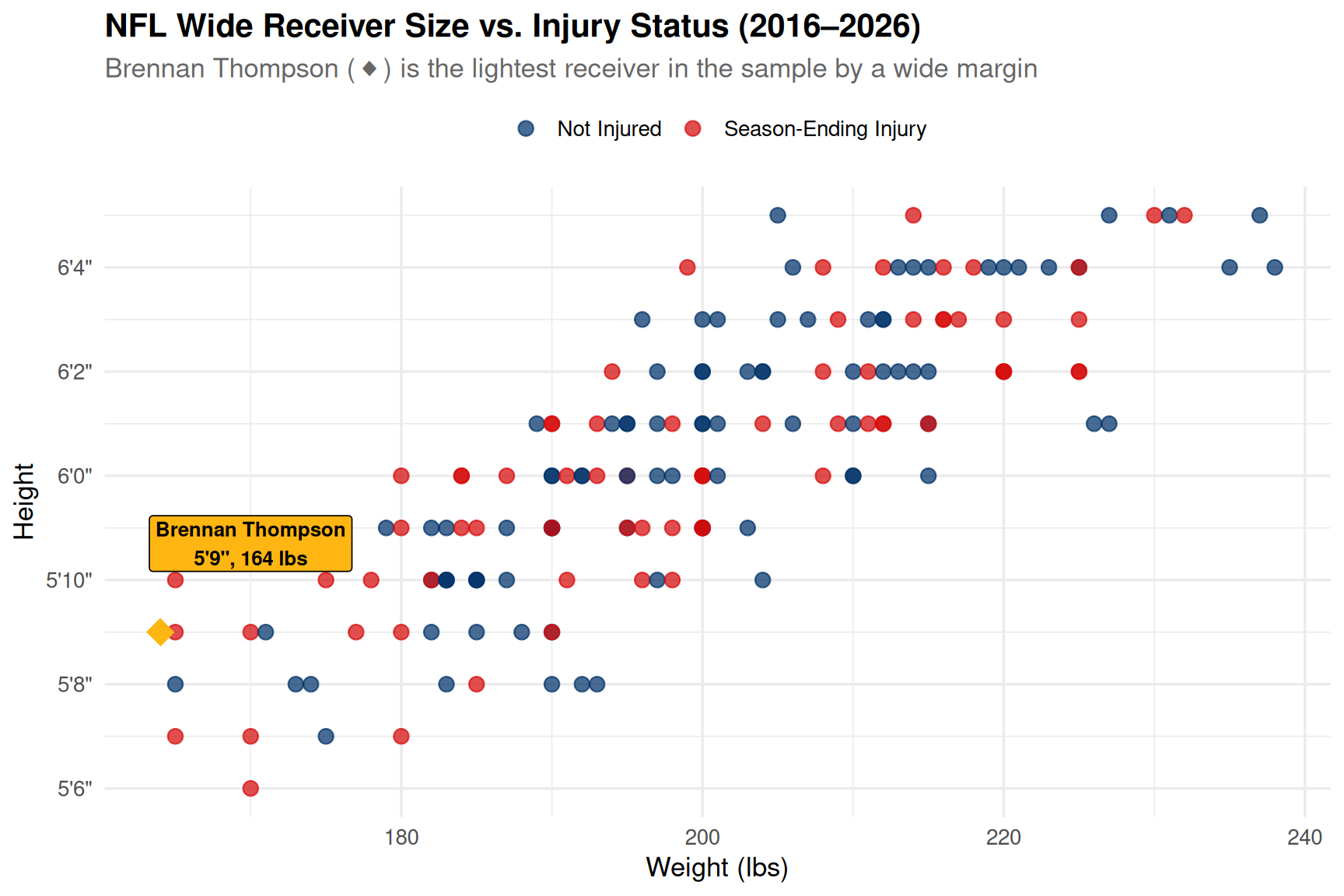
Thompson sits well below and to the left of the entire sample. There is no comparable player in this dataset — at 164 lbs, he is more than 15 lbs lighter than the next lightest receiver. The scatter also shows that injured and non-injured players are broadly intermixed across the size spectrum, with no obvious clustering pattern.
### Distribution by Injury Status
```{r}
#| label: boxplots
#| fig-width: 10
#| fig-height: 5
pal_fill <- c("Not Injured" = "#013369", "Season-Ending Injury" = "#D50A0A")

box_theme <- theme_minimal(base_size = 13) +
  theme(plot.title = element_text(face = "bold", size = 12))

print(
  ggplot(df, aes(x = Injured, y = Height_in, fill = Injured)) +
    geom_boxplot(alpha = 0.75, outlier.shape = 21, outlier.fill = "white") +
    scale_fill_manual(values = pal_fill, guide = "none") +
    scale_y_continuous(breaks = seq(66, 78, 2), labels = fmt_height) +
    labs(title = "Height by Injury Status", x = NULL, y = "Height") +
    box_theme
)
print(
  ggplot(df, aes(x = Injured, y = Weight_lbs, fill = Injured)) +
    geom_boxplot(alpha = 0.75, outlier.shape = 21, outlier.fill = "white") +
    scale_fill_manual(values = pal_fill, guide = "none") +
    labs(title = "Weight by Injury Status", x = NULL, y = "Weight (lbs)") +
    box_theme
)
```
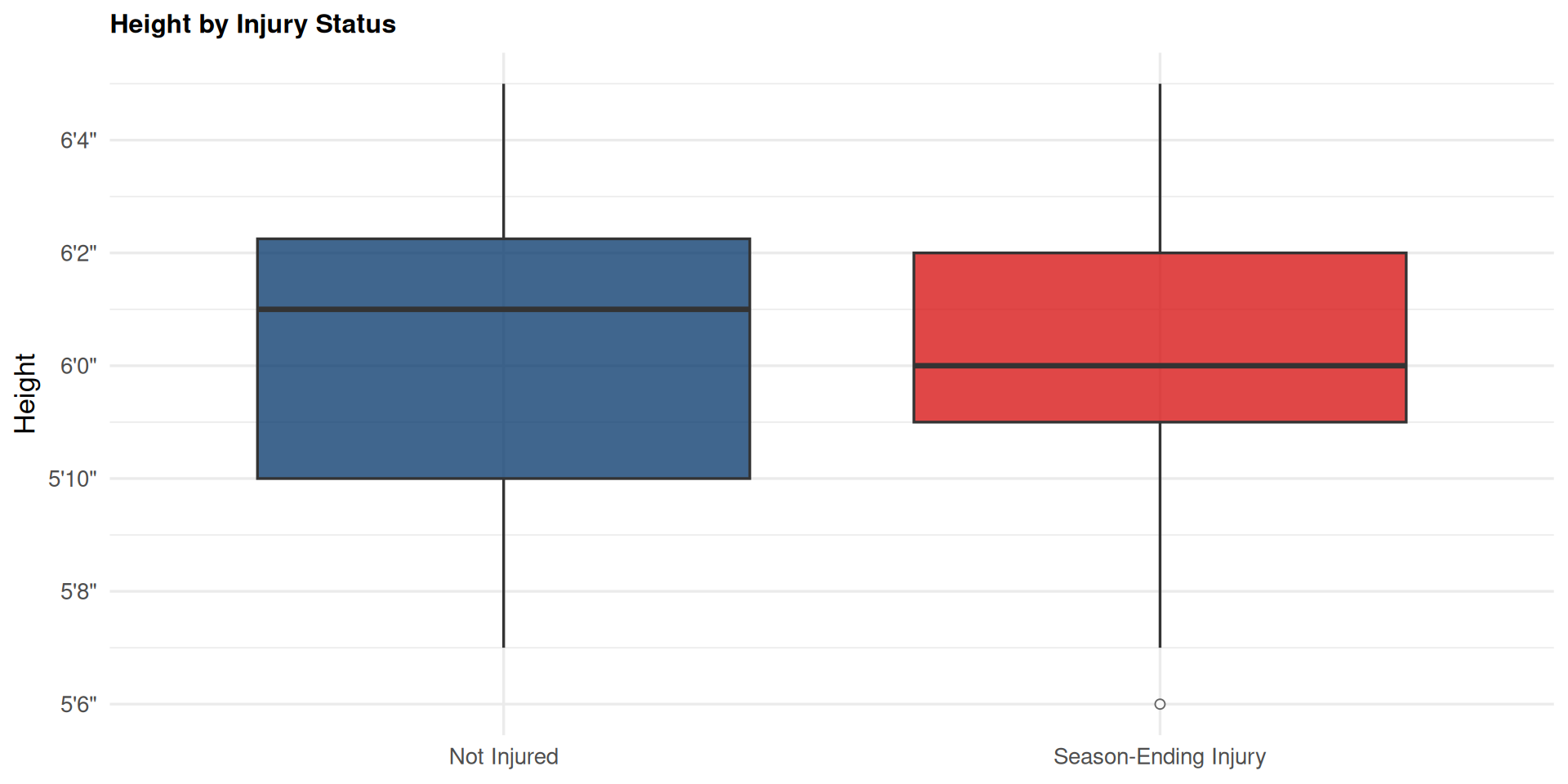
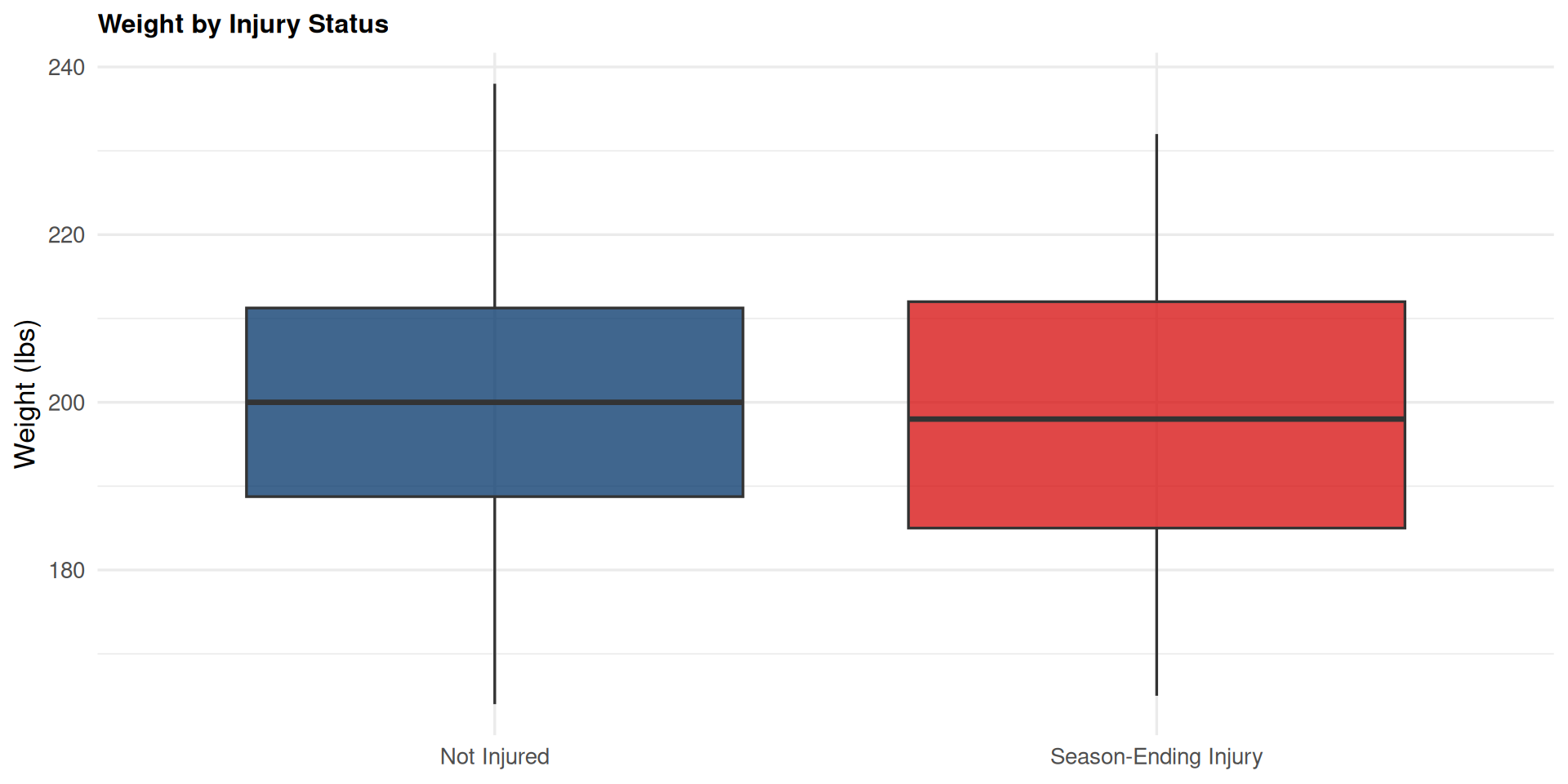
The medians are close between groups for both height and weight. The injured group shows slightly wider spread — particularly at the upper end of the weight range — but there is no dramatic size difference between the two populations.
### Injury Rate by Size Group
```{r}
#| label: bar-rates
#| fig-width: 10
#| fig-height: 5
med_h <- median(df$Height_in)
med_w <- median(df$Weight_lbs)

df_g <- df %>%
  mutate(
    Height_group = if_else(
      Height_in >= med_h,
      paste0("Tall (≥ ", fmt_height(med_h), ")"),
      paste0("Short (< ", fmt_height(med_h), ")")
    ),
    Weight_group = if_else(
      Weight_lbs >= med_w,
      paste0("Heavy (≥ ", med_w, " lbs)"),
      paste0("Light (< ", med_w, " lbs)")
    )
  )

rate_h <- df_g %>%
  group_by(Height_group) %>%
  summarize(rate = mean(Injured_raw) * 100, n = n(), .groups = "drop") %>%
  mutate(Height_group = fct_reorder(Height_group, -rate))

rate_w <- df_g %>%
  group_by(Weight_group) %>%
  summarize(rate = mean(Injured_raw) * 100, n = n(), .groups = "drop") %>%
  mutate(Weight_group = fct_reorder(Weight_group, -rate))

bar_theme <- theme_minimal(base_size = 13) +
  theme(
    plot.title = element_text(face = "bold", size = 12),
    panel.grid.major.x = element_blank()
  )

print(
  ggplot(rate_h, aes(x = Height_group, y = rate, fill = rate)) +
    geom_col(alpha = 0.88, width = 0.55) +
    geom_text(
      aes(label = sprintf("%.0f%%\n(n=%d)", rate, n)),
      vjust = -0.35, fontface = "bold", size = 4
    ) +
    scale_fill_gradient(low = "#013369", high = "#D50A0A", guide = "none") +
    ylim(0, 72) +
    labs(title = "Injury Rate by Height Group", x = NULL, y = "% with Season-Ending Injury") +
    bar_theme
)
print(
  ggplot(rate_w, aes(x = Weight_group, y = rate, fill = rate)) +
    geom_col(alpha = 0.88, width = 0.55) +
    geom_text(
      aes(label = sprintf("%.0f%%\n(n=%d)", rate, n)),
      vjust = -0.35, fontface = "bold", size = 4
    ) +
    scale_fill_gradient(low = "#013369", high = "#D50A0A", guide = "none") +
    ylim(0, 72) +
    labs(title = "Injury Rate by Weight Group", x = NULL, y = "% with Season-Ending Injury") +
    bar_theme
)
```
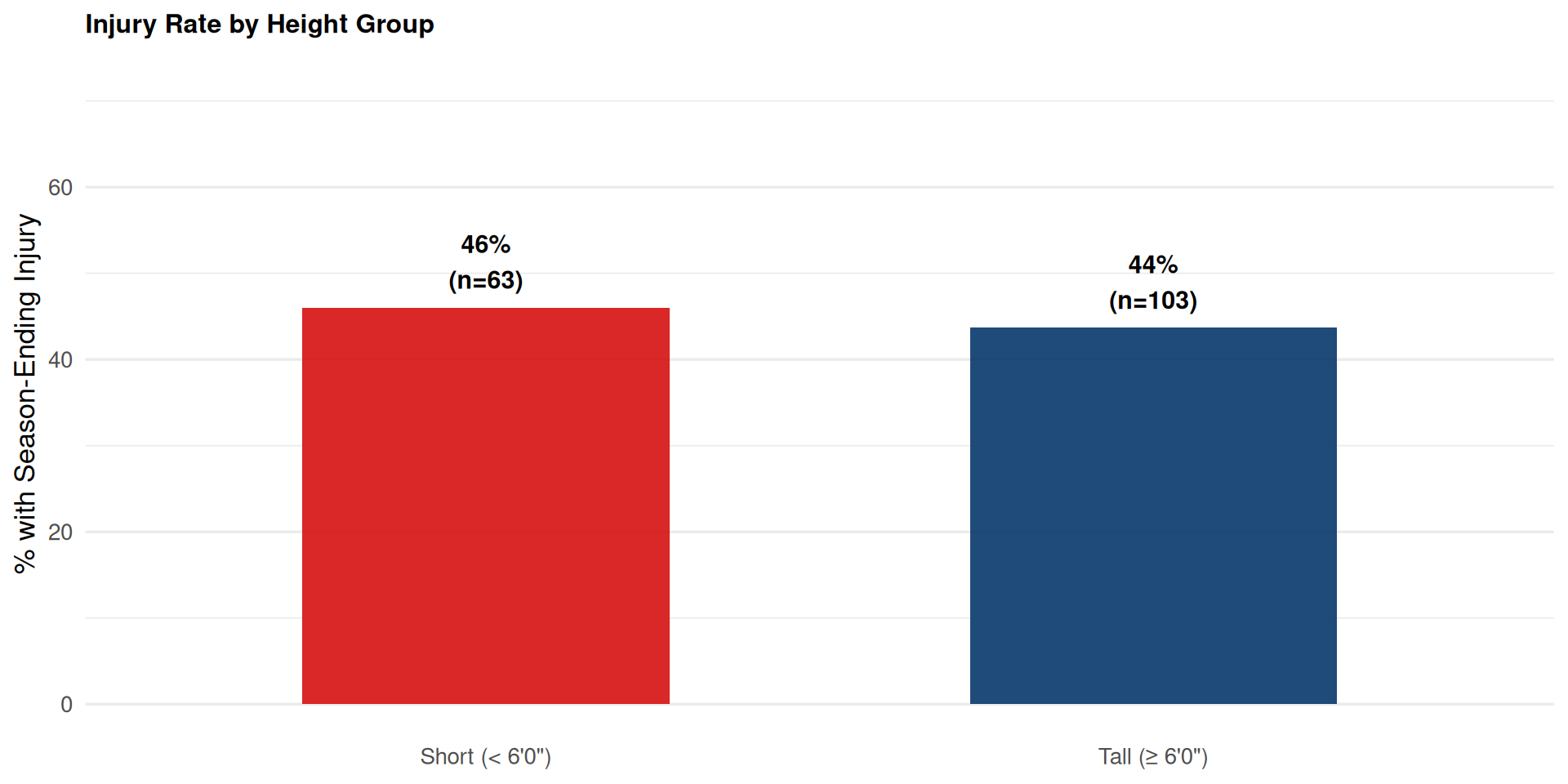
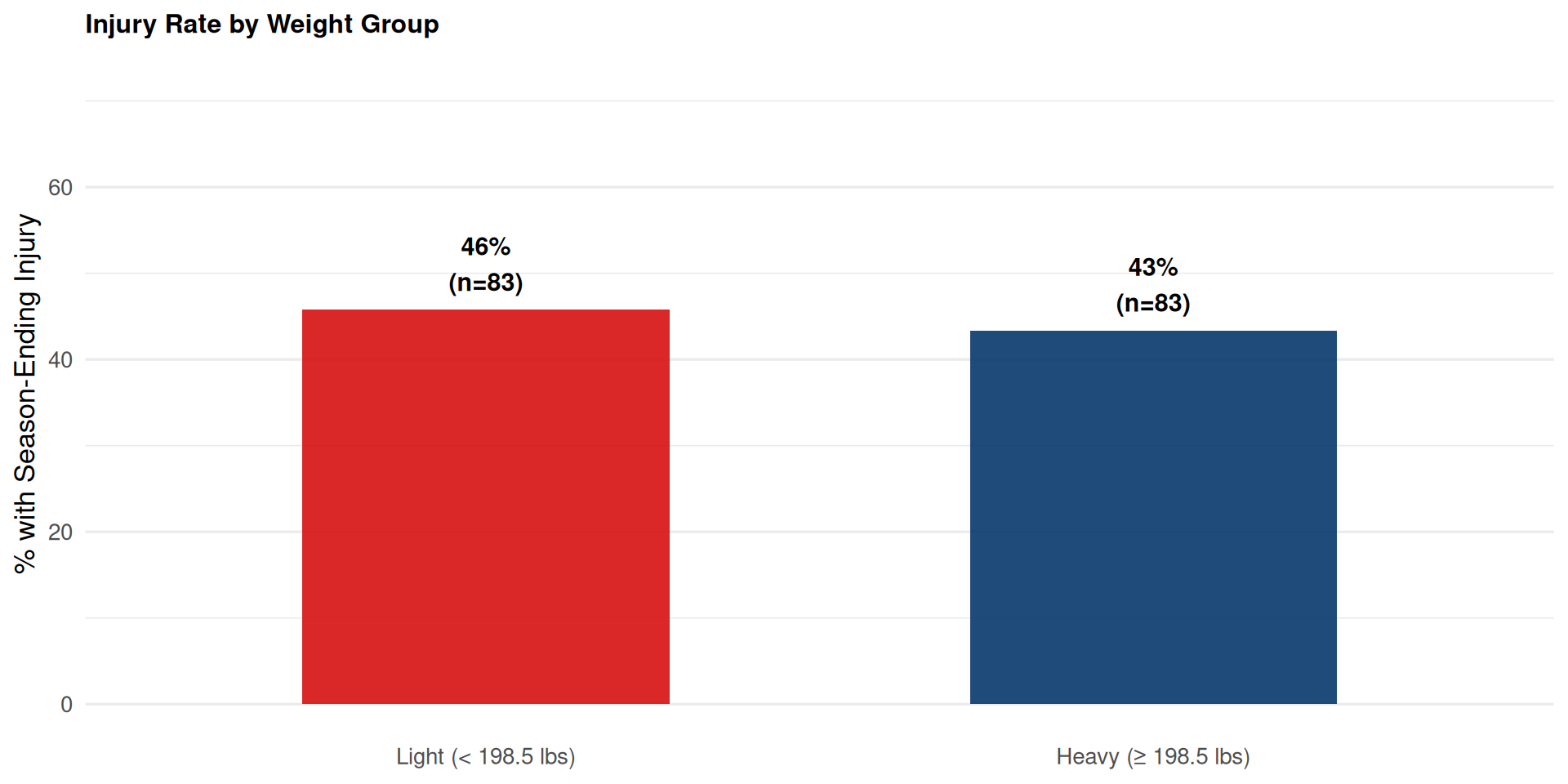
When splitting at the median, a counterintuitive pattern emerges: **taller and heavier receivers show higher injury rates** in this sample. This cuts against the intuition that smaller receivers might be more fragile. That said, the groups are roughly equal in size and the differences are modest — strong conclusions require more data and controls.
### Weight Distribution: Injured vs. Not Injured
```{r}
#| label: density
#| fig-width: 9
#| fig-height: 5
ggplot(df, aes(x = Weight_lbs, fill = Injured, color = Injured)) +
  geom_density(alpha = 0.35, linewidth = 1) +
  geom_vline(
    xintercept = brennan$Weight_lbs,
    linetype = "dashed", color = "#B8860B", linewidth = 1
  ) +
  annotate(
    "text", x = brennan$Weight_lbs + 3, y = 0.025,
    label = "Thompson\n164 lbs", hjust = 0,
    color = "#8B6914", fontface = "bold", size = 3.6
  ) +
  scale_fill_manual(values = pal_fill) +
  scale_color_manual(values = pal_fill) +
  labs(
    title = "Weight Distribution: Injured vs. Not Injured Receivers",
    subtitle = "Brennan Thompson falls well below the bulk of both distributions",
    x = "Weight (lbs)", y = "Density",
    fill = NULL, color = NULL
  ) +
  theme_minimal(base_size = 13) +
  theme(
    legend.position = "top",
    plot.title = element_text(face = "bold"),
    plot.subtitle = element_text(color = "gray40")
  )
```
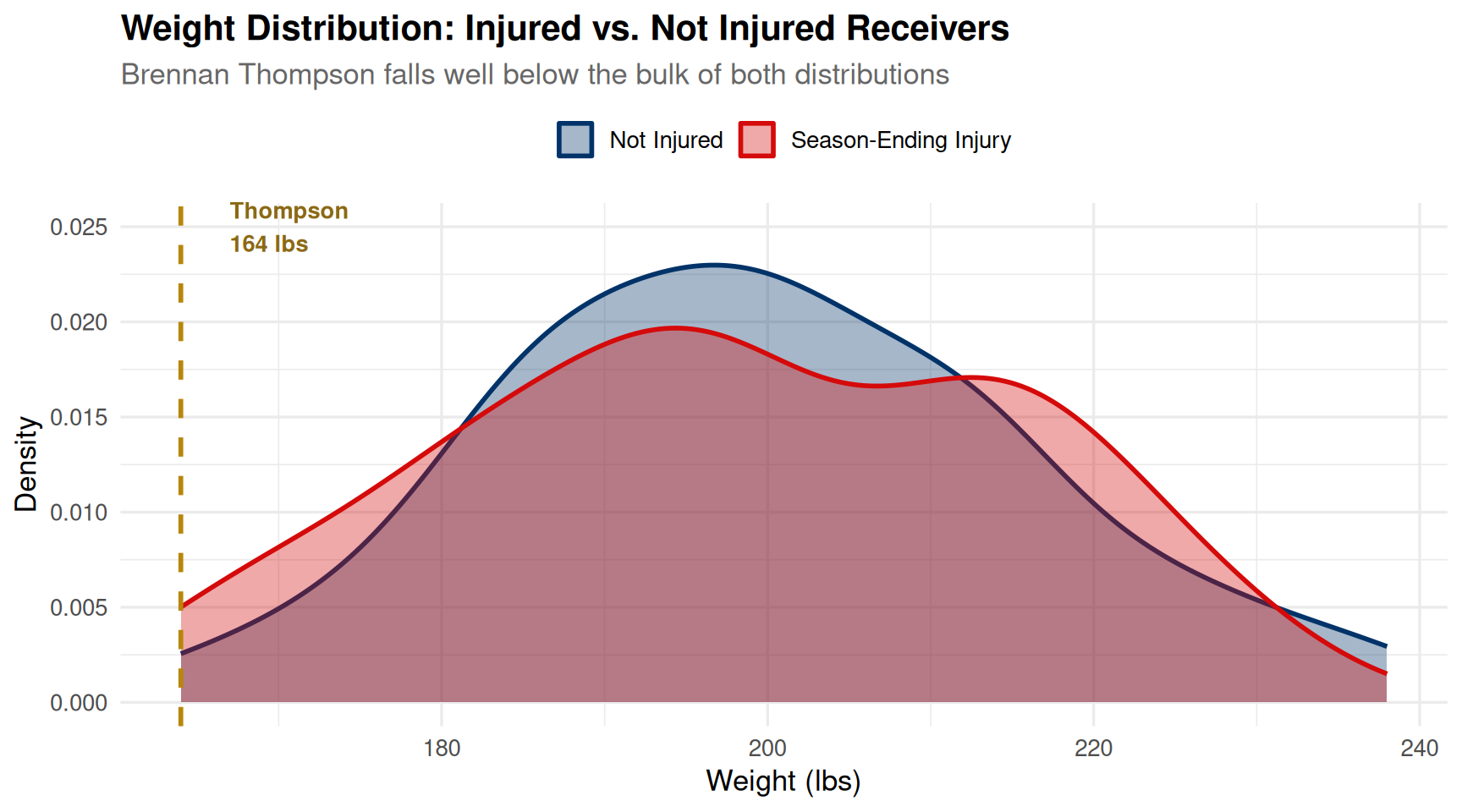
Both distributions peak around 195–215 lbs and overlap substantially — weight alone is not cleanly separating injured from non-injured receivers. Thompson's 164 lbs sits far to the left of both curves, in territory with no historical precedent in this sample.
## Takeaways
- At **5'9", 164 lbs**, Brennan Thompson is a genuine outlier — no comparable receiver appears in this sample of 170 notable NFL wideouts over the past decade.
- **Size alone does not predict season-ending injuries** in this data: the distributions between injured and non-injured groups overlap heavily.
- If anything, **larger receivers show slightly higher injury rates** when split at the median, which runs counter to the "fragile small receiver" narrative.
- The more meaningful concern for Thompson may not be injury frequency but **durability at the point of contact** — a question this dataset can't answer without play-type and contact data.
*This is an exploratory, descriptive analysis. With ~170 players and no controls for position role, snap count, age, or playing style, these patterns are observational — not causal.*